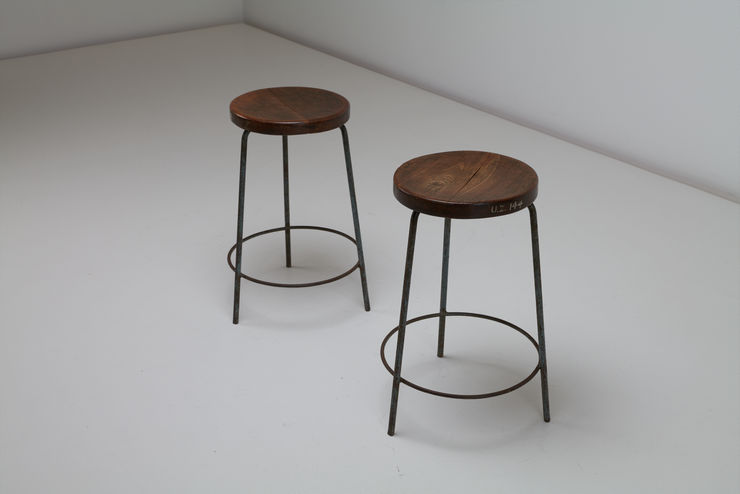
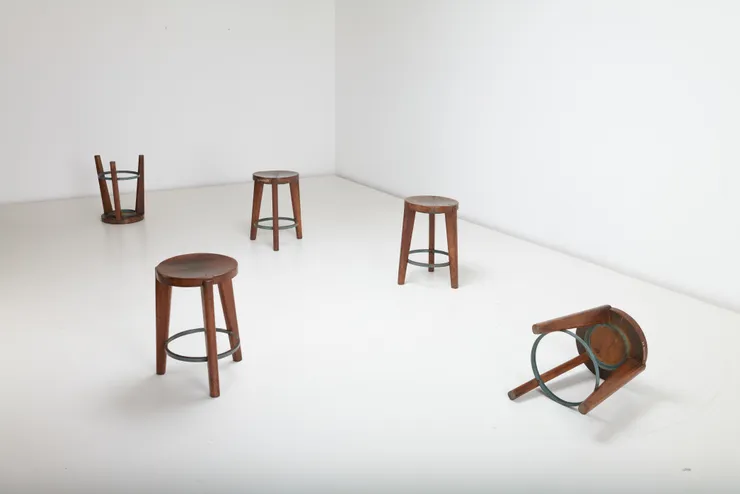
Pierre Jeanneret Small Stools, c.1960


Pierre Jeanneret
Small Stools, c1960
Solid teak & painted, patinated iron
Diameter - Top 33cm - Base 42cm base - Top 13 inches - Base 16½ inches
Height - 50cm - 19½ inches
Height - 50cm - 19½ inches
From the Post Graduate Institute, Chandigarh India
Sold in singles or in sets.
Sold in singles or in sets.
£2,500 each + VAT
Further images
A collection of original Pierre Jeanneret small stools, dating from circa 1960 and produced for the Post Graduate Institute in Chandigarh, India. The stools combine solid teak seats with simple...
A collection of original Pierre Jeanneret small stools, dating from circa 1960 and produced for the Post Graduate Institute in Chandigarh, India.
The stools combine solid teak seats with simple painted iron tripod bases, a direct piece of utilitarian furniture designed for everyday institutional use. The circular teak tops have the characteristic concave surface found on Jeanneret's Chandigarh stools, softening the substantial timber and making them surprisingly comfortable to sit on.
All of the stools came from the Post Graduate Institute and many retain their original painted P.G.I. institutional markings around the edge of the seat. They have spent several decades in use, and this history is clearly visible across every example.
All of the teak seats are original and have developed different depths and variations of patina. Some retain small flecks of old paint, others have minor chips, and all have numerous dents, dings, scratches and marks accumulated through decades of use. No two are quite the same, but all have excellent patina and show their age exactly as we would want them to.
The iron bases are equally interesting. Areas of old paint remain alongside oxidation, rubbing and exposed metal, creating a surface that could only have developed naturally over time. When the stools are turned over, the underside and iron construction reveal this especially clearly. In our experience, this type of wear and oxidation is exactly what we expect to see on Jeanneret stools of this age that have spent their working lives in Chandigarh's institutional buildings.
The construction itself is extremely simple. Three slender iron legs support the substantial circular teak seat and are connected by an intersecting geometric footrest. The result is a very architectural piece of furniture, with the thin linear iron structure contrasting beautifully with the weight and warmth of the solid teak top.
Although originally designed simply as stools, we find these pieces remarkably versatile. Their scale allows them to work equally well as occasional side tables or plant stands, either individually or arranged in groups. Their architectural form also gives them a strong presence despite occupying very little space.
The stools have been carefully restored in London. The teak has been cleaned and waxed while retaining the original surface, marks and accumulated patina. The iron bases have likewise been cleaned without removing the oxidation, remaining paint or evidence of their long working lives. The intention has been to make each stool structurally sound and entirely usable without making it look newly restored.
The stools are available individually, and we also have sufficient examples to create larger groups. As the colour of the teak, depth of patina, surviving paint and institutional markings vary from stool to stool, we are happy to select and photograph the best-matched group for a particular requirement.
We have specialised in Pierre Jeanneret furniture for nearly nineteen years and have extensive experience in identifying, sourcing, restoring and selling his work. Given the number of later reproductions and incorrectly attributed pieces now on the market, we understand the importance of provenance, construction, materials and restoration when assessing Chandigarh furniture. We are always happy to discuss these aspects in detail and answer any questions regarding the attribution, provenance or restoration of our Chandigarh pieces.
Viewing is warmly welcomed at our West London showroom.
High-resolution photographs, detailed condition reports and video inspections are available upon request.
We offer local, national and international shipping.
Please contact us for further information or to arrange a private viewing.
Literature
E. Touchaleaume and G. Moreau, Le Corbusier, Pierre Jeanneret: L’Aventure Indienne, Gourcuff Gradenigo, Paris, 2010, pp. 425, 426 and 570, similar model PJ-SI-58-A illustrated.
L. and P. Seguin, Le Corbusier, Pierre Jeanneret: Chandigarh, India, 1951–66, Galerie Patrick Seguin, Paris, 2014, p. 214, similar model illustrated.
Related artworks
-
 Pierre Jeanneret, Pair of Blue Stools , 1960 Sold
 -
Pierre Jeanneret, Medium Stools - Set of Three, 1960£9000 + VAT
-
Pierre Jeanneret, Stools, 1960 Sold
-
Pierre Jeanneret , Stools, 1965 Sold
-
Pierre Jeanneret, Low Stools - Set of Five, 1960£12,500 + VAT
-
Pierre Jeanneret, Work Table, 1960-61 Sold