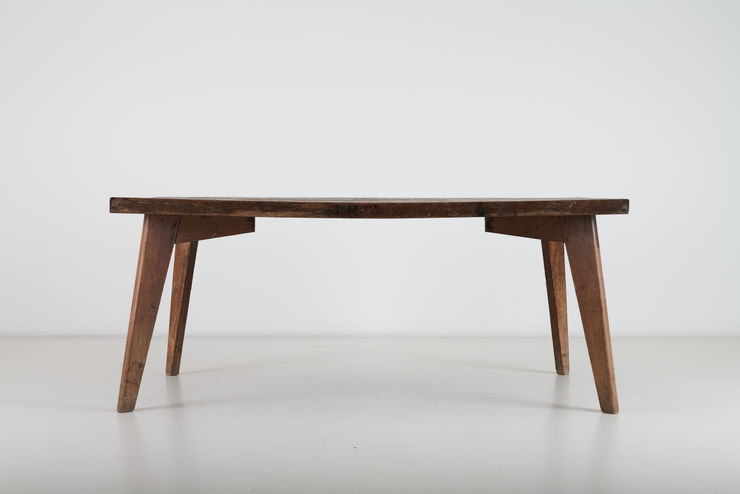
Pierre Jeanneret Work Table, 1960–61


Pierre Jeanneret
Work Table, 1960-61
Solid Burmese teak with sisso banding
Width - 184 cm - 72½ inches
Depth - 91 cm - 35¾ inches
Height - 75 cm - 29½ inches
Depth - 91 cm - 35¾ inches
Height - 75 cm - 29½ inches
From the Mechanical Engineering College, Chandigarh India
Sold
Further images
-
(View a larger image of thumbnail 1
)

-
(View a larger image of thumbnail 2
)

-
(View a larger image of thumbnail 3
)

-
(View a larger image of thumbnail 4
)

-
(View a larger image of thumbnail 5
)

-
(View a larger image of thumbnail 6
)

-
(View a larger image of thumbnail 7
)

-
(View a larger image of thumbnail 8
)

An exceptional Pierre Jeanneret Work Table, dating from 1960–61 and reportedly from the Mechanical Engineering College in Chandigarh. Constructed from solid teak with rosewood banding, this is one of a...
An exceptional Pierre Jeanneret Work Table, dating from 1960–61 and reportedly from the Mechanical Engineering College in Chandigarh. Constructed from solid teak with rosewood banding, this is one of a group of five tables that we were fortunate enough to acquire together, all of which displayed an extraordinary level of original institutional patina.
When we purchased the group, we were told that the five tables had come from the Mechanical Engineering College. Several retained institutional markings of different kinds, while others were unmarked. Their construction, dimensions and exceptional surfaces were remarkably consistent across the group. While we do not have documentary provenance confirming the original location, we believe the provenance given to us to be correct.
The construction is simple, architectural and extremely well resolved. The rectangular top is formed from substantial solid teak planks contained within a contrasting rosewood outer band. Beneath, four splayed solid teak legs are arranged as two structural end assemblies, with angled supporting members connecting the legs to the underside of the tabletop. The resulting structure is exceptionally strong while remaining visually light and completely open through the centre.
The underside is almost as interesting as the top. It reveals the construction particularly clearly, together with old fixing points, markings and the accumulated evidence of decades of use. All of the principal components are original, including the tabletop, rosewood banding, supporting structure and legs.
For us, however, it is the surface of the tabletop that makes this particular example so special. The level and variation of patina are extraordinary and far beyond what we would normally expect to find on one of these tables.
Across the teak are layers of wear accumulated through decades of institutional use. Names, initials and patterns have been etched into the surface, alongside numerous holes, deep scratches, cuts and marks. Some areas appear to have been drilled, while others have what look like saw cuts running into the timber. There are also areas of scorching and burn marks which we believe may have resulted from welding or possibly from bending or working heated metal on the tabletop, although it is impossible to know precisely how these marks were created.
The result is a surface with enormous depth. Different areas of the teak have aged at different rates, ranging from warm reddish brown through much darker areas of almost blackened timber. Scratches, cuts, holes, burns, drawings and traces of old paint sit on top of one another, creating a record of the table's working life that could only have developed through prolonged and intensive use.
A large blue painted inscription remains prominently visible on the tabletop. The script is Hindi and translates as “painter”. We believe this marking was added at some point during the table's working life rather than when the table was originally made. It has subsequently aged into the surrounding surface and has itself become part of the history and patina of the piece.
This level of surface is not something we normally encounter, even on original Chandigarh furniture. We have always been highly selective when buying Pierre Jeanneret tables, and the opportunity to choose from this particular group allowed us to select examples with exceptionally strong surfaces. All of the tables we acquired were good, but the depth of patina on this example is rare.
The table has been structurally restored by our trusted conservator, with the emphasis firmly placed on preserving its original material and surface. It has been lightly cleaned and waxed rather than refinished, retaining the scratches, cuts, holes, burn marks, inscriptions, variations in colour and accumulated institutional wear. All parts of the table are original and it is now structurally solid and fully usable.
We also have another Work Table acquired as part of the same group. It is the same size and has a remarkably similar depth of patina, together with a surviving blue painted Hindi character on the top, approximately corresponding to the first syllable of the inscription seen on this table.
The two tables work extremely well as individual pieces but would also be particularly interesting used together. Placed end to end they create a table approximately 368 cm long, while positioned alongside one another they form an unusually large near-square work or dining surface of approximately 184 × 182 cm. Given their shared provenance, dimensions, construction and closely related surfaces, they have a natural relationship that would be extremely difficult to assemble retrospectively.
At 184 cm long and 91 cm deep, the table is also a very practical size on its own. Although originally made as institutional furniture, it works equally well today as a work table or dining table. The open structure provides generous legroom, while the splayed teak supports give the table a strong architectural presence from every angle.
We have specialised in Pierre Jeanneret furniture for nearly nineteen years and have extensive experience in identifying, sourcing, restoring and selling his work. Given the number of later reproductions and incorrectly attributed pieces now on the market, we understand the importance of provenance, construction, materials and restoration when assessing Chandigarh furniture. We are always happy to discuss these aspects in detail and answer any questions regarding the attribution, provenance or restoration of our Chandigarh pieces.
Viewing is warmly welcomed at our West London showroom.
High-resolution photographs, detailed condition reports and video inspections are available upon request.
We offer local, national and international shipping.
Please contact us for further information or to arrange a private viewing.
Literature
E. Touchaleaume and G. Moreau, Le Corbusier, Pierre Jeanneret: L’Aventure Indienne, Gourcuff Gradenigo, Paris, 2010, pp. 330–331, 420–421 and 583, model PJ-TA-01-A illustrated; drawing of the model illustrated p. 583.
L. and P. Seguin, Le Corbusier, Pierre Jeanneret: Chandigarh, India, 1951–66, Galerie Patrick Seguin, Paris, 2014, pp. 232–235 and 286, model illustrated.
Related artworks
-
 Pierre Jeanneret, Set of 10 'Box' Chairs , 1958 Sold
 -
Pierre Jeanneret, Writing Chair, 1962£4000 + vat
-
Pierre Jeanneret, Work Table, 1960-61 Sold
-
Pierre Jeanneret, Work Table, 1960-61 Sold
-
Pierre Jeanneret, Work Table, 1960-61 Sold
-
Pierre Jeanneret, Work Table, 1960-61 Reserved
-
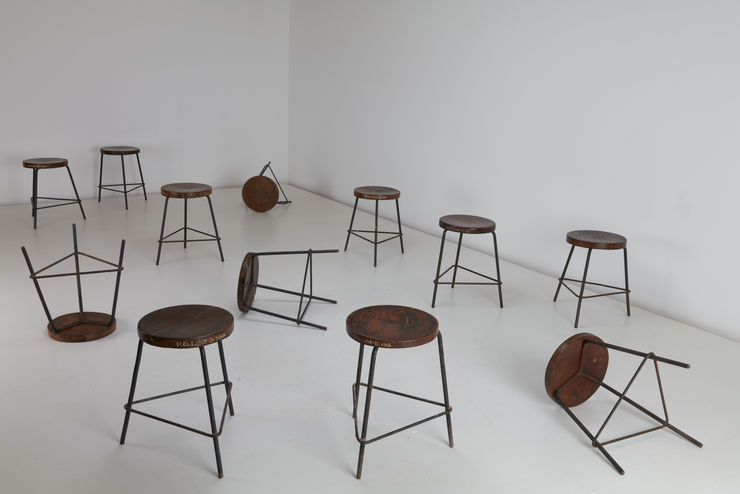
Pierre Jeanneret, Small Stools, c1960£2,500 each + VAT
-
Pierre Jeanneret, Low Stools - Set of Five, 1960£12,500 + VAT