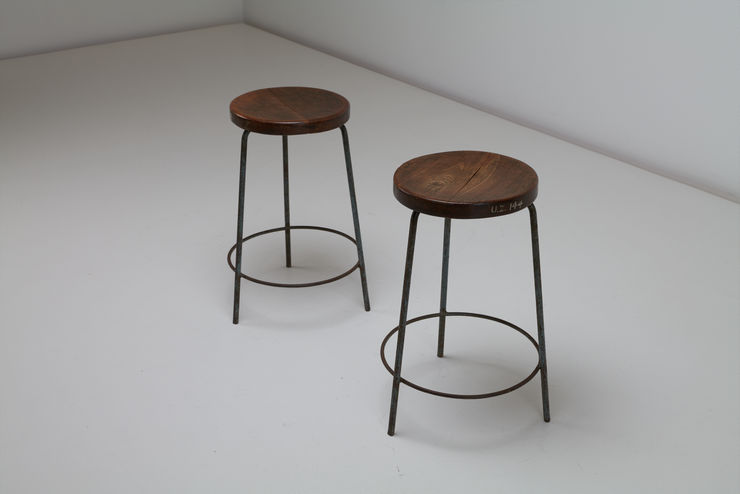
Pierre Jeanneret Work Table, 1960–61


Pierre Jeanneret
Work Table, 1960-61
Solid teak
Width - 184 cm - 72½ inches
Depth - 91 cm - 35¾ inches
Height - 75 cm - 29½ inches
Depth - 91 cm - 35¾ inches
Height - 75 cm - 29½ inches
From the Panjab University, Chandigarh India.
Reserved
Further images
-
(View a larger image of thumbnail 1
)

-
(View a larger image of thumbnail 2
)

-
(View a larger image of thumbnail 3
)

-
(View a larger image of thumbnail 4
)

-
(View a larger image of thumbnail 5
)

-
(View a larger image of thumbnail 6
)

-
(View a larger image of thumbnail 7
)

-
(View a larger image of thumbnail 8
)

-
(View a larger image of thumbnail 9
)

-
(View a larger image of thumbnail 10
)

-
(View a larger image of thumbnail 11
)

-
(View a larger image of thumbnail 12
)

-
(View a larger image of thumbnail 13
)

-
(View a larger image of thumbnail 14
)

An exceptional Pierre Jeanneret Work Table, dating from 1960–61 and originally from Panjab University, Chandigarh. Constructed entirely from solid teak, this is one of those pieces where decades of institutional...
An exceptional Pierre Jeanneret Work Table, dating from 1960–61 and originally from Panjab University, Chandigarh. Constructed entirely from solid teak, this is one of those pieces where decades of institutional use have transformed a relatively simple piece of furniture into something quite extraordinary.
The construction is straightforward but beautifully resolved. The large rectangular top is formed from four substantial solid teak planks set within a teak outer frame. Beneath, the four splayed legs are arranged as two pairs, with each pair incorporated into a single structural end assembly supporting the tabletop. The angled legs and shaped supporting members create a frame that is architectural, strong and extremely well made, while leaving the centre beneath the table completely open.
It is a construction that we particularly like. There is nothing unnecessary, yet when viewed from the side or underneath, the relationship between the splayed legs and supporting structure gives the table a strong geometric quality. Despite the substantial timber and obvious strength of the frame, it remains visually light.
What makes this particular table stand out for us, however, is its surface. All of the Chandigarh furniture we select has good patina, but occasionally we find a piece where the accumulated wear and colour have developed into something exceptional. This is one of those pieces.
The top has seen decades of heavy daily institutional use. There are numerous holes, dents, scratches, cuts and pen marks across the teak, together with names, initials, lines and shapes scratched into both the tabletop and frieze. Many of these appear to have been incised using the point of a compass or similar instrument, presumably by students during the table's long life at the university. Some are immediately visible while others only become apparent when looking closely at the surface. Areas of the timber have worn considerably darker than others, while other sections have been rubbed back through continual use, revealing warmer tones beneath.
For us, the resulting surface is almost like an abstract expressionist painting. Layers of dark brown, black, reddish and lighter teak run across the four planks, interrupted by scratches, pen marks, drawings, names, old holes and traces left by generations of use. It is a surface that has developed slowly over many decades and simply could not be convincingly replicated. The excessive wear is not something we would want to remove; it is precisely what makes this table so special.
The same is true of the frame and legs. Their patination is equally good, and when the table is viewed from below the difference between the upper and lower sections of the legs becomes particularly apparent. The bottom third has developed a noticeably different surface through contact, cleaning, movement and daily use. These variations are exactly the sort of details we look for in Chandigarh furniture and provide tangible evidence of a long working life.
An original institutional marking, R.M. 12, remains visible on the frieze. This is understood to refer to Room 12 at Panjab University and is another surviving detail from its institutional history.
The table has warped slightly with age. The top is essentially flat and entirely usable, but it is not perfectly uniform. For us, this actually adds to the piece rather than detracting from it. The slight movement in the four teak planks belongs naturally with the extraordinary wear and accumulated surface and is entirely consistent with a table that has spent decades in intensive institutional use.
One corner of the tabletop has also received a small inserted timber repair. Again, rather than attempting to disguise the history of the table, the approach throughout the restoration has been to preserve as much original material and surface as possible.
The table has been fully structurally restored by our trusted conservator, with the emphasis firmly placed on conservation rather than renewal. It has been lightly cleaned and waxed, while the holes, dents, scratches, pen marks, carved names and initials, graffiti, variations in colour and accumulated institutional patina have deliberately been retained. The table is structurally sound and fully usable while still presenting very much as an old Chandigarh table.
At 184 cm long and 91 cm deep, it is also an extremely practical size. Although originally conceived as institutional furniture, it works equally well today as a work table / desk or dining table. The open construction provides generous space beneath the top, while the splayed end structures give the table a strong architectural presence from every angle.
We have always been highly selective when buying Pierre Jeanneret tables, choosing only examples we consider particularly good, and for us this table stands out. The construction itself is beautifully considered, but it is the extraordinary surface that elevates this particular piece. The depth of patina, built-up colour and evidence of decades of use are what make it exceptional. It is exactly the kind of surface we look for in original Chandigarh furniture and one that age alone can create.
We have specialised in Pierre Jeanneret furniture for nearly nineteen years and have extensive experience in identifying, sourcing, restoring and selling his work. Given the number of later reproductions and incorrectly attributed pieces now on the market, we understand the importance of provenance, construction, materials and restoration when assessing Chandigarh furniture. We are always happy to discuss these aspects in detail and answer any questions regarding the attribution, provenance or restoration of our Chandigarh pieces.
Viewing is warmly welcomed at our West London showroom.
High-resolution photographs, detailed condition reports and video inspections are available upon request.
We offer local, national and international shipping.
Please contact us for further information or to arrange a private viewing.
Literature
E. Touchaleaume and G. Moreau, Le Corbusier, Pierre Jeanneret: L’Aventure Indienne, Gourcuff Gradenigo, Paris, 2010, pp. 330–331, 420–421 and 583, model PJ-TA-01-A illustrated; drawing of the model illustrated p. 583.
L. and P. Seguin, Le Corbusier, Pierre Jeanneret: Chandigarh, India, 1951–66, Galerie Patrick Seguin, Paris, 2014, pp. 232–235 and 286, model illustrated.
Related artworks
-
 Pierre Jeanneret, Pair of Easy Chairs, 1958 Sold
-
Pierre Jeanneret, Work Table, 1960-61 Sold
-
Pierre Jeanneret, Work Table, 1960-61 Sold
-
Pierre Jeanneret, Stools, 1960 Sold
-
Pierre Jeanneret, Low Stools - Set of Five, 1960£12,500 + VAT
-
Pierre Jeanneret, Work Table, 1960-61 Sold