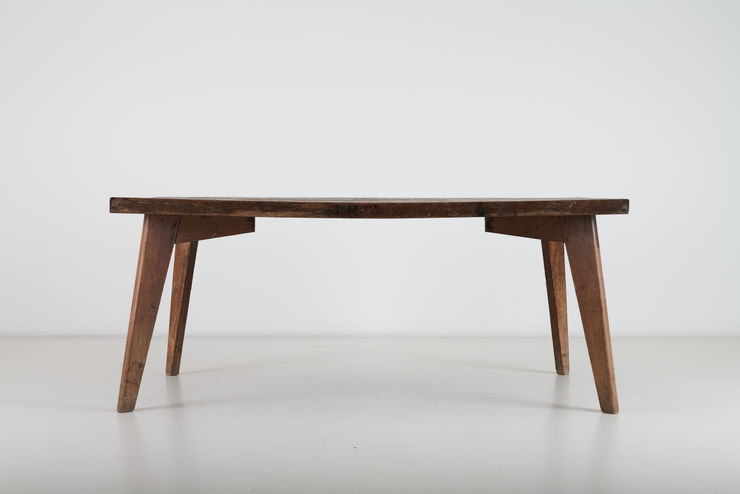
Pierre Jeanneret
Pair of Easy Chairs, 1958
Teak & cane
Width - 52cm - 20½ inches
Depth - 74cm - 29 inches
Height - 70cm - 27½ inches
Seat Height - 36cm - 14 inches
Depth - 74cm - 29 inches
Height - 70cm - 27½ inches
Seat Height - 36cm - 14 inches
From the Panjab University Auditorium, Chandigarh India.
Each chair marked on back accordingly.
Each chair marked on back accordingly.
Sold
Further images
-
(View a larger image of thumbnail 1
)

-
(View a larger image of thumbnail 2
)

-
(View a larger image of thumbnail 3
)

-
(View a larger image of thumbnail 4
)

-
(View a larger image of thumbnail 5
)

-
(View a larger image of thumbnail 6
)
-
(View a larger image of thumbnail 7
)
-
(View a larger image of thumbnail 8
)

-
(View a larger image of thumbnail 9
)

-
(View a larger image of thumbnail 10
)

-
(View a larger image of thumbnail 11
)

An exceptional matched pair of Pierre Jeanneret Easy Chairs, dating from circa 1958 and originally produced for Panjab University, Chandigarh. We purchased these chairs ourselves in Chandigarh more than fifteen...
An exceptional matched pair of Pierre Jeanneret Easy Chairs, dating from circa 1958 and originally produced for Panjab University, Chandigarh.
We purchased these chairs ourselves in Chandigarh more than fifteen years ago and have lived with and used them at the gallery ever since. Both retain the painted institutional marking “U. Auditorium”, identifying them with the University Auditorium at Panjab University.
Although the chairs started life together and are identical in their proportions and construction, their surfaces have aged quite differently. When we bought them, one of the chairs had evidently spent time in a room that had been whitewashed and was covered with small flecks of white paint. These washed away relatively easily, but the surface beneath had developed differently from its companion.
For us, this difference has always been part of the story of the chairs rather than something we wanted to correct. One has a lighter, more varied surface while the other retains areas of deeper colour. Both have numerous scratches, dents, worn edges and marks accumulated during their institutional life. Together they make a matched pair without looking artificially identical, and over the years this is something we have come to like more and more.
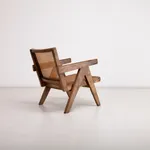
The chairs are constructed entirely from solid Burmese teak, with the substantial V-shaped side supports meeting beneath the long horizontal arms. The low seat and gently reclined back give the chairs their characteristic profile, while the back itself has a subtle curve rather than being completely flat. It is a small detail, but one that makes a noticeable difference to both the shape and comfort of the chair.
There is another detail that makes this pair unusual. When we acquired the chairs, one still retained remnants of its original cane, although it was broken in numerous places and a sheet of plywood had at some point been nailed over the seat to keep the chair usable. The small nail holes from this plywood remain visible in the seat frame. We made no attempt to disguise them; they are part of the working history of the chair.
Importantly, the surviving original cane showed that the chairs had been woven using the traditional six-way caning method. This is unusual amongst the Chandigarh chairs we have handled, where a simpler two-way weave is much more commonly encountered.
Six-way caning uses considerably more material and is substantially more time-consuming to execute. When the chairs were restored, we therefore made the deliberate decision to reproduce the original six-way weave rather than replace it with the simpler two-way cane seen on most of our other Chandigarh seating. It was considerably more work, but for these chairs we felt it was important to retain this original detail.
The decision has also proved itself in use. We have used these chairs regularly for more than fifteen years, always with a cushion on the seat, and the cane remains remarkably good. There are no breaks, significant dips or obvious signs of wear to the weave.
Both chairs were structurally restored by our trusted conservator. All of the Burmese teak components are original to the chairs. The timber was lightly cleaned and waxed while preserving the accumulated patina, surface variation, marks and evidence of their earlier institutional use.
These are chairs we will genuinely miss. We have owned many Pierre Jeanneret pieces over the years and have always been selective about the examples we bought in Chandigarh, but this pair has remained with us for more than fifteen years for a reason. The proportions are right, the Burmese teak surfaces are beautiful, the U. Auditorium markings give them a clear institutional history, and the unusual six-way cane preserves a detail of their original construction that we rarely encounter.
For us, they are two exceptional examples of Pierre Jeanneret's Easy Chair. Whoever owns them next will not simply be buying a matched pair, but two chairs that have each developed their own history while remaining together.
We have specialised in Pierre Jeanneret furniture for nearly nineteen years and have extensive experience in identifying, sourcing, restoring and selling his work. Given the number of later reproductions and incorrectly attributed pieces now on the market, we understand the importance of provenance, construction, materials and restoration when assessing Chandigarh furniture. We are always happy to discuss these aspects in detail and answer any questions regarding the attribution, provenance or restoration of our Chandigarh pieces.
Viewing is warmly welcomed at our West London showroom.
High-resolution photographs, detailed condition reports and video inspections are available upon request.
We offer local, national and international shipping.
Please contact us for further information or to arrange a private viewing.
Related artworks
-
 Pierre Jeanneret, Work Table, 1960-61 Reserved
 -
Pierre Jeanneret , Easy Chair , 1958
-
Pierre Jeanneret, Club Chairs, 1958/59 Sold
-
Pierre Jeanneret, Easy Chairs, 1958 Sold
-
Architect Designed, Teak & Rope Low Slung Armchairs , 1960s