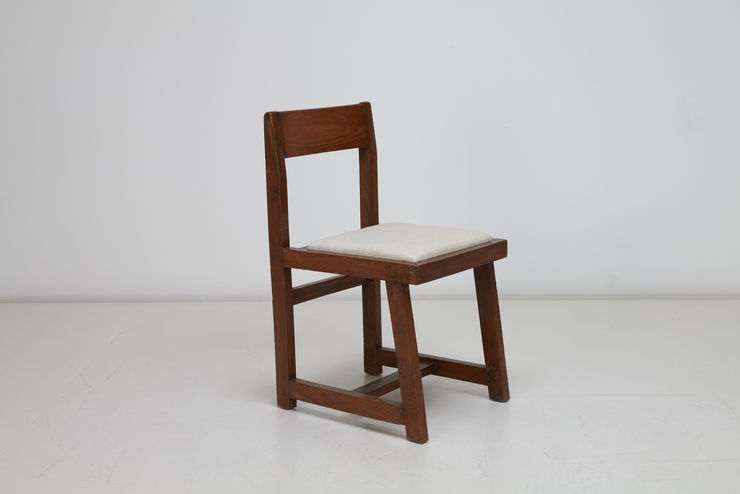
Pierre Jeanneret
Box Chair, 1960
Burmese teak frame with cane seat
Width - 41 cm - 16¼ inches
Depth - 47.5 cm - 18¾ inches
Height - 78 cm - 30¾ inches
Seat Height - 44 cm - 17¼ inches
Depth - 47.5 cm - 18¾ inches
Height - 78 cm - 30¾ inches
Seat Height - 44 cm - 17¼ inches
From a goverment building, Chandigarh, India
Sold
Further images
An original Pierre Jeanneret Box Chair, dating from circa 1960 and made for the Chandigarh project in India. The Box Chair is one of Jeanneret’s more restrained institutional chair designs....
An original Pierre Jeanneret Box Chair, dating from circa 1960 and made for the Chandigarh project in India.
The Box Chair is one of Jeanneret’s more restrained institutional chair designs. Constructed entirely around a solid teak frame, it combines a woven cane seat with a broad, gently curved solid teak backrest. The design is extremely simple, with very little unnecessary detail, but the proportions and construction give the chair a strong architectural presence.
The rear uprights continue from floor level to support the backrest, while the front legs are set at a slight angle beneath the seat. At floor level the legs are connected by rectangular timber frames, creating the distinctive box-like construction from which the chair takes its name. Seen from the side, this simple geometry is particularly clear.
This example came from a government building in Chandigarh and retains a hand-inscribed marking to the reverse of the backrest. We believe this may relate to the person who originally used the chair rather than to the building itself, although we cannot confirm this. It is a small but appealing detail that provides another trace of the chair's long working life in Chandigarh.
The solid teak has developed a deep, dark patina over decades of use. There are numerous scratches, marks, dents and variations in colour across the frame, particularly around the backrest and legs. For us, these surfaces are an integral part of original Chandigarh furniture and have deliberately been preserved rather than refinished.
All of the timber components are original to the chair. The frame has been fully structurally restored by our trusted conservator, then lightly cleaned and waxed while preserving the historical patina and evidence of use.
As is usual with the Chandigarh chairs we restore, the cane has been replaced. New cane is necessary to make the chair practical and safe to use, but we deliberately age the replacement cane sympathetically so that it sits comfortably alongside the much older teak rather than appearing conspicuously new. The result retains the contrast between the lighter woven cane and the heavily patinated timber without making the restoration look overly fresh.
For us, this is a particularly good example of how little Jeanneret needed to create a distinctive piece of furniture. There is no decorative element beyond the materials and construction themselves. The broad curved backrest, open rectangular structure and slightly angled front legs give what was essentially a straightforward institutional chair a very recognisable form.
The chair remains completely practical for use, while the depth of patina and surviving hand-inscribed marking give it the individuality we look for when buying original Chandigarh furniture.
We have specialised in Pierre Jeanneret furniture for nearly nineteen years and have extensive experience in identifying, sourcing, restoring and selling his work. Given the number of later reproductions and incorrectly attributed pieces now on the market, we understand the importance of provenance, construction, materials and restoration when assessing Chandigarh furniture. We are always happy to discuss these aspects in detail and answer any questions regarding the attribution, provenance or restoration of our Chandigarh pieces.
Viewing is warmly welcomed at our West London showroom.
High-resolution photographs, detailed condition reports and video inspections are available upon request.
We offer local, national and international shipping.
Please contact us for further information or to arrange a private viewing.
Literature
E. Touchaleaume and G. Moreau, Le Corbusier, Pierre Jeanneret: L’Aventure Indienne, Gourcuff Gradenigo, Paris, 2010, p. 570, model PJ-SI-54-A illustrated.
L. and P. Seguin, Le Corbusier, Pierre Jeanneret: Chandigarh, India, 1951–66, Galerie Patrick Seguin, Paris, 2014, pp. 208–209 and 285, model illustrated.
Related artworks
-
 Pierre Jeanneret, Teak & Cane Stool, 1960 Sold
 -
Pierre Jeanneret, Set of 10 'Box' Chairs , 1958 Sold
-
Pierre Jeanneret, Box Ladder Chairs, 1958 Sold
-
Pierre Jeanneret, V Type Chair, 1958-59£5,000 + vat
-
Pierre Jeanneret, Rare Child's Chair, 1958£2,500 + vat
-
Pierre Jeanneret & Eulie Chowdhury, Library Chair, 1952-56£3,750 + vat
-
Pierre Jeanneret, Box Cushion Chair , 1960 Sold
-
Pierre Jeanneret, Box Armchairs, Set of Four, 1953-54 Sold