


Pierre Jeanneret
Conference Armchair, 1953-54
Solid teak and cane
Width - 48 cm - 19 inches
Depth - 60 cm - 23 ½ inches
Height - 78 cm - 30¾ inches
Seat Height - 43 cm - 17 inches
Depth - 60 cm - 23 ½ inches
Height - 78 cm - 30¾ inches
Seat Height - 43 cm - 17 inches
Sold
Further images
-
(View a larger image of thumbnail 1
)

-
(View a larger image of thumbnail 2
)
-
(View a larger image of thumbnail 3
)

-
(View a larger image of thumbnail 4
)

-
(View a larger image of thumbnail 5
)

-
(View a larger image of thumbnail 6
)

-
(View a larger image of thumbnail 7
)

-
(View a larger image of thumbnail 8
)

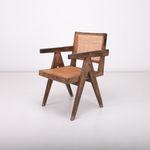
A particularly good example of a Pierre Jeanneret Conference Armchair, dating from circa 1953–54 and originally made for the administrative buildings of Chandigarh, India. Constructed from solid Burmese teak with...
A particularly good example of a Pierre Jeanneret Conference Armchair, dating from circa 1953–54 and originally made for the administrative buildings of Chandigarh, India.
Constructed from solid Burmese teak with a cane seat and back, the chair has the strong architectural structure associated with Jeanneret’s early Chandigarh seating. The broad armrests are supported by substantial angled side frames, while the gently curved back and slightly reclined seating position soften what is otherwise a very direct and functional construction.
What makes this particular chair stand out for us is the surface of the Burmese teak. It retains its original polished finish, which has worn naturally through decades of institutional use. The patination is strongest exactly where we would expect to find it: across the arms, around the upper corners and on the areas of the frame that would have been repeatedly handled. Elsewhere, more of the original polished surface survives, creating considerable variation in both colour and texture across the chair.
This unevenness is something we particularly like. It provides a very visible record of how the chair was used rather than simply giving the timber an overall aged appearance. There are knocks, marks and areas of wear throughout, but these sit naturally within the original surface and give the chair the depth of patina that we look for in Chandigarh furniture.
When buying individual Conference Armchairs, we have always tried to be especially selective. A single chair has to stand on its own, and for us the quality and originality of the timber, surface and patina become even more important. This is an especially good example and one we chose because of the condition and character of its original teak.
All of the timber has been carefully cleaned and waxed rather than stripped or refinished, allowing the surviving original polish, wear and variation in colour to remain visible. The chair has been conserved by our trusted conservator and made structurally solid, while retaining as much of the original material and surface as possible.
The original cane had reached the end of its usable life and has been replaced to both the seat and back. The new cane has been carefully toned to sit naturally alongside the aged Burmese teak rather than having the very pale appearance of newly woven cane.
We have specialised in Pierre Jeanneret furniture for nearly nineteen years and have extensive experience in identifying, sourcing, restoring and selling his work. Given the number of later reproductions and incorrectly attributed pieces now on the market, we understand the importance of provenance, construction, materials and restoration when assessing Chandigarh furniture. We are always happy to discuss these aspects in detail and answer any questions regarding the attribution, provenance or restoration of our Chandigarh pieces.
Viewing is warmly welcomed at our West London showroom.
High-resolution photographs, detailed condition reports and video inspections are available upon request.
We offer local, national and international shipping.
Please contact us for further information or to arrange a private viewing.
Provenance
From a government building, Chandigarh India
Related artworks
-
 Pierre Jeanneret , Easy Chair , 1958
 -
Pierre Jeanneret, Conference Armchairs, 1953-54 Sold
-
Pierre Jeanneret, Conference Armchair Set of 10, 1953-54 Sold
-
Pierre Jeanneret, V Type Chair, 1958-59
-
Pierre Jeanneret, Writing Chair, 1962
-
Pierre Jeanneret & Eulie Chowdhury, Library Chair , 1952-56 Reserved


