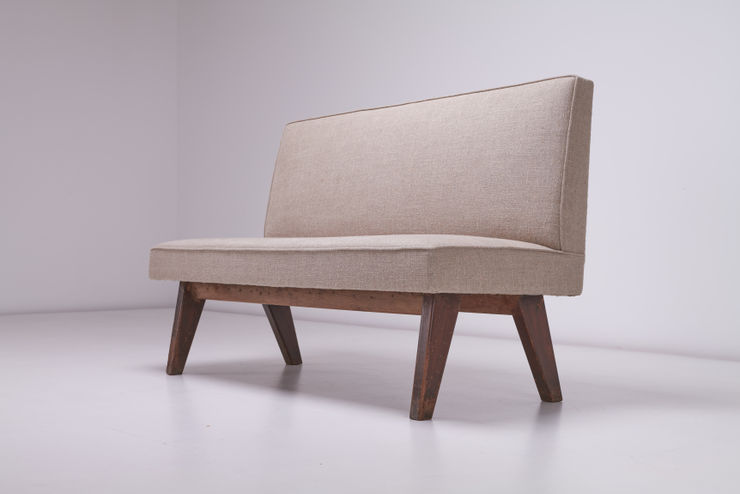
Pierre Jeanneret
Demountable Rope Chairs & Sofa, 1953-54
Burmese teak frame, cotton strapping and rope back
Sofa
Width - 134 cm - 52¾ inches
Depth - 61 cm - 24 inches
Height - 70 cm - 27½ inches
Seat Height - 36 cm - 14¼ inches
Chairs
Width - 52.5 cm - 20¾ inches
Depth - 60 cm - 23½ inches
Height - 69.5 cm - 27¼ inches
Seat Height - 36 cm - 14¼ inches
Width - 134 cm - 52¾ inches
Depth - 61 cm - 24 inches
Height - 70 cm - 27½ inches
Seat Height - 36 cm - 14¼ inches
Chairs
Width - 52.5 cm - 20¾ inches
Depth - 60 cm - 23½ inches
Height - 69.5 cm - 27¼ inches
Seat Height - 36 cm - 14¼ inches
From a private residence, Chandigarh India
£45,000 + vat @ 20% for UK sales
Further images
A very rare and particularly good set of Pierre Jeanneret Demountable seating, comprising a pair of chairs and matching sofa, dating from circa 1953–54 and originally made for a very...
A very rare and particularly good set of Pierre Jeanneret Demountable seating, comprising a pair of chairs and matching sofa, dating from circa 1953–54 and originally made for a very small number of private residences in Chandigarh, India.
The set is constructed from solid Burmese teak, with woven cotton webbing to the seats and a series of horizontal cotton ropes forming the backs. The design is remarkably light and open, particularly when compared with much of Jeanneret's later Chandigarh furniture. Slender tapered uprights form both the legs and back supports, while the almost weightless rope backs provide a striking contrast to the dark, heavily patinated teak.
The term “Demountable” refers to the unusual nut-and-bolt construction used to connect the principal elements of the frames. In theory this allowed the furniture to be dismantled, although in practical terms it seems unlikely that this was something regularly done. Jeanneret used this method of construction on only a relatively small group of Chandigarh designs, which have subsequently become known collectively as his Demountable furniture.
The unusually low proportions are also significant. Traditional Indian domestic life included informal ways of sitting on, or close to, the floor, and Jeanneret's early furniture for Chandigarh frequently explored similarly low forms of seating. This Demountable seating and the better-known Kangaroo Chair are particularly good examples, both placing the sitter considerably lower than conventional European seating of the period.
This low, informal approach was particularly well suited to the more relaxed domestic interiors of Chandigarh. Period photographs show this model being used within a very small number of private residences, including Jeanneret's own home. Examples were also used by the British architects Maxwell Fry and Jane Drew, who worked alongside Jeanneret on the development of Chandigarh and furnished their own home there with Chandigarh furniture.
Fry and Drew subsequently brought examples of Chandigarh furniture back to Britain when they returned from India. Examples of this Demountable seating associated with them later appeared at auction, providing an important surviving link between the furniture used by Chandigarh's architectural team and the domestic interiors they created for themselves.
An important period reference appears in the December 1961 issue of Marg magazine devoted to Chandigarh. A room setting containing this model is captioned “Furniture by P. Jeanneret & Eulie Chowdhury.” The photograph contains several different pieces of furniture, so it is not possible to determine from the caption whether Chowdhury had any direct involvement in the design of this particular model. Chowdhury worked closely with Jeanneret in Chandigarh and was herself responsible for furniture designs, including low forms of seating, so some involvement is entirely possible. However, without further evidence we believe the correct attribution for this particular model remains Pierre Jeanneret alone rather than a co-designed piece. We nevertheless think the Marg caption is an interesting and important historical reference to record.
The sofa and two chairs offered here were purchased together as a set and are original to one another. All of the wooden components are original and constructed from Burmese teak. The proportions are particularly elegant, with relatively slender sections of timber giving the furniture the lightness apparent in period photographs.
Over the years we have seen other examples of this model in India, some constructed from noticeably heavier sections of timber and generally without the depth of surface found on this set. For us, the proportions, construction and patination of these three pieces correspond particularly convincingly with the examples visible in period photographs. They are among the best examples of the model we have seen.
One of the things that particularly distinguishes this set is the remarkable consistency of the patina across all three pieces. This is something we always look for when assessing furniture that is said to have remained together, and it is rare to encounter a group where the surfaces have aged so beautifully and so coherently. The colour, wear and finish of the sofa and both chairs relate naturally to one another, giving the set the appearance of three pieces that have aged together over many decades.
The surface of the Burmese teak is particularly good. The finish appears to be the original polished surface, with the rubbing, knocks, scratches and subtle variations in colour that have accumulated through years of use. During restoration the timber was only gently cleaned before being waxed over the existing polish, preserving rather than refinishing the original surface and the depth of patina that had developed over time.
All three pieces were also structurally restored by our conservator, with the intention throughout being to retain as much original material and surface as possible. All of the wooden components remain original.
The original cotton seat webbing had reached the end of its usable life and was therefore replaced. The construction is particularly interesting: rather than using individual straps, the seat is formed from one long continuous length of cotton webbing, repeatedly wrapped around the timber frame and interwoven to create the complete seat. The result is deceptively simple. The woven construction provides considerable strength while also producing a surprisingly comfortable and slightly yielding seat.
The replacement webbing follows the construction and pattern of the original. The rope forming the backs had similarly deteriorated and has also been replaced. In both cases we referred closely to period photographs to reproduce the original arrangement and appearance as accurately as possible.
Period photographs show these pieces being used with loose seat cushions and, in some interiors, with additional back cushions. We have deliberately not made cushions for this set, preferring to leave the choice of fabric and finish to its eventual owner. We would be very happy to arrange for appropriate cushions to be made in a fabric of the client's choice.
The chairs themselves are very rare, while the matching sofa is considerably rarer. What makes this group particularly special is finding the sofa and two chairs together, all acquired as a set and retaining their original timber components. In nearly nineteen years of dealing in Pierre Jeanneret furniture, we cannot recall seeing another complete set of this model offered for sale.
For us, this is one of the most successful examples of Jeanneret's early Chandigarh seating. There is an extraordinary economy to the design: very little material is required to create a piece of furniture with such a strong presence. The slender teak frame, woven seat and almost graphic horizontal lines of the rope back give the pieces a lightness that distinguishes them from much of his better-known institutional furniture.
Having seen a number of examples in India over the years, we consider this one of the best groups of the model we have encountered. The combination of the unusually slender proportions, beautifully preserved original surfaces, remarkably consistent patina across all three pieces, demountable construction and the exceptional rarity of the matching sofa makes it a particularly special set for us.
We have specialised in Pierre Jeanneret furniture for nearly nineteen years and have extensive experience identifying, sourcing, restoring and selling his work. Given the number of later reproductions and incorrectly attributed pieces now on the market, we understand the importance of provenance, construction, materials and restoration when assessing Chandigarh furniture.
We are always happy to discuss these aspects in detail and answer any questions regarding the authenticity, provenance or restoration of our Jeanneret pieces.
Viewing is warmly welcomed at our West London showroom.
High-resolution photographs, detailed condition reports and video inspections are available upon request.
We offer local, national and international shipping.
Please contact us for further information or to arrange a private viewing.
Related artworks
-
 Pierre Jeanneret, Club Chairs, 1958/59 Sold
 -
Pierre Jeanneret, Kangaroo Sofa & Chairs , 1955
-
Architect Designed, Teak & Rope Low Slung Armchairs , 1960s
-
Pierre Jeanneret, Public Bench / Sofa, 1954-55
-
Pierre Jeanneret, Kangaroo Chairs, 1955
-
Pierre Jeanneret, Public Bench, 1954-55 Sold
-
Pierre Jeanneret , Chest of Drawers, 1955
-
Pierre Jeanneret & Eulie Chowdhury, Library Chair, 1952-56
-
Pierre Jeanneret & Eulie Chowdhury, Library Chair , 1952-56 Reserved
-
Indian, Tree Trunk Table - Tronc d'arbre, 1950s - 60s