Le Corbusier, Charlotte Perriand & Pierre Jeanneret, Chaise LC 104, c.1959–64


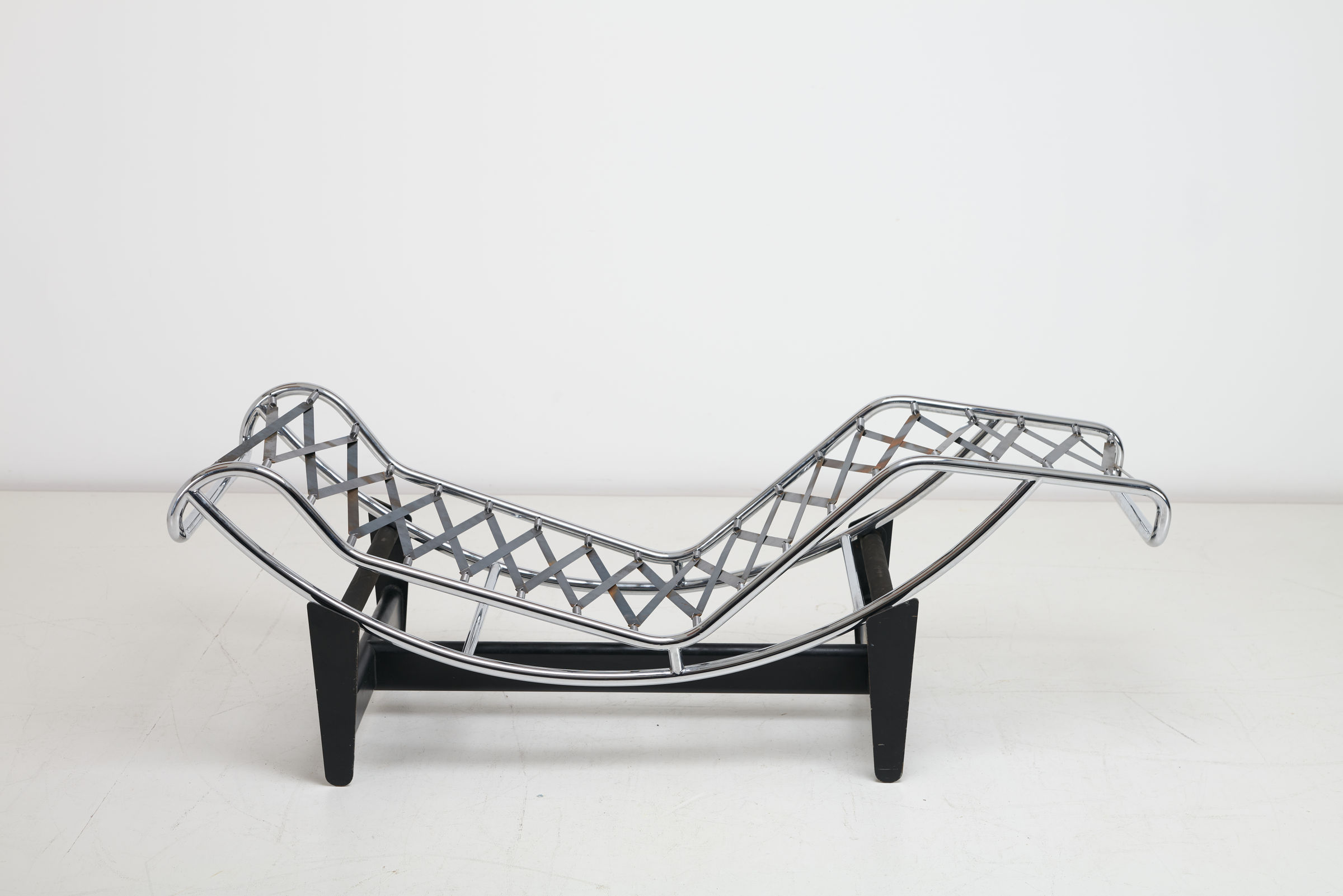


Le Corbusier, Charlotte Perriand & Pierre Jeanneret
Chaise LC 104, c1959-64
Tubular steel, leather & hide
Width - 160 cm - 63 inches
Depth - 57 cm - 22½ inches
Height - 62 cm - 27½ inches
Depth - 57 cm - 22½ inches
Height - 62 cm - 27½ inches
Painted metal, chromium-plated metal, hide, leather.
Produced by Heidi Weber, Zurich, Switzerland.
Produced by Heidi Weber, Zurich, Switzerland.
£4950
Further images
This example represents a rare and historically significant survival from one of the most complex and compelling production histories in 20th-century design. Though long attributed solely to Le Corbusier, the...
This example represents a rare and historically significant survival from one of the most complex and compelling production histories in 20th-century design.
Though long attributed solely to Le Corbusier, the chaise longue was originally conceived in 1929 by Charlotte Perriand, developed in collaboration with Le Corbusier and his cousin Pierre Jeanneret, and marketed under their joint names. Patented in 1929 and initially designated Model B 306, the design entered commercial production with Thonet in 1930.
At the time, Le Corbusier required that his name take precedence in the authorship. The model was offered in two versions: a canvas-covered edition at 1,650 francs and a more luxurious hide-covered “de luxe” version at 3,070 francs, comparable to the present example. Despite its radical modernist aesthetic, sales were modest, with only 172 examples sold between June 1930 and July 1935. Thonet ceased production entirely in 1937.
Subsequent variations followed, including licensed and sub-licensed examples by Embru in the 1930s and unlicensed production by Wohnbedarf beginning in 1950.
Following the Second World War, Le Corbusier's growing international stature led to renewed interest in his early tubular steel furniture. In 1959 he granted a licence to Heidi Weber in Zurich to manufacture the series and entrusted her with the sale of his drawings and paintings. At this stage, he stipulated sole authorship and renamed the model the LC 104. Weber's carefully controlled production continued until 1965, when the rights were sub-licensed to Cassina in Italy, marking the beginning of the model's rebirth as the LC4.
Construction details confirm that the present chaise originates from this short-lived and important Heidi Weber production period. It therefore represents a crucial transitional chapter in the design's evolution, bridging its avant-garde origins in the late 1920s with the internationally recognised icon it would later become.
Weber-period examples are particularly important for their rarity and historical integrity, as well as for their place within the complicated authorship and production history of one of modernism's defining designs.
As with all our vintage pieces, this chaise has been carefully inspected and sympathetically restored by a specialist restorer, with the aim of preserving its historical character while ensuring it remains practical and fully usable.
All springs have been custom-made and replaced to match the original size and coil count. The wadding within the mattress and bolster has been renewed, and the supporting straps strengthened throughout. The entire piece has been professionally cleaned and carefully prepared.
The leather bolster has worn beautifully over time and remains soft to the touch. The hide mattress shows a few minor areas of hair loss consistent with age; these are subtle and do not detract from the overall presentation. The chaise retains a rich, authentic patina and remains as visually compelling and fully usable today as when first produced.
A rare opportunity to acquire an important Heidi Weber-period example of one of the seminal designs of 20th-century modernism.
Viewing is warmly welcomed at our West London showroom.
High-resolution photographs, detailed condition reports and video inspections are available upon request.
We offer local, national and international shipping.
Please contact us for further information or to arrange a private viewing.
Provenance
Dame Mary Quant, London
Purchased from desendents
Private Collection, London
Literature
Jacques Barsac, Charlotte Perriand: Complete Works, Volume 3, 1956–1968, Scheidegger & Spiess, Zurich, 2017, pp. 122–128, Heidi Weber production discussed and illustrated.
1
of
313
Related artworks
-
 LE CORBUSIER, PIERRE JEANNERET & CHARLOTTE PERRIAND, CHAISE LONGUE MODEL LC4 - Villa Church, 2013 Sold
 -
Le Corbusier, Pierre Jeanneret & Charlotte Perriand, LC4 Chaise Longue, 1990s Sold
-
Marcel Breuer, 'Long Chair', 1935/36£19,500
-
Tuareg , Leather & Reed Rug, 1950s£5750
-
Le Corbusier, Pierre Jeanneret & Charlotte Perriand, Cassina LC3 Sofa, 1980's Sold


